

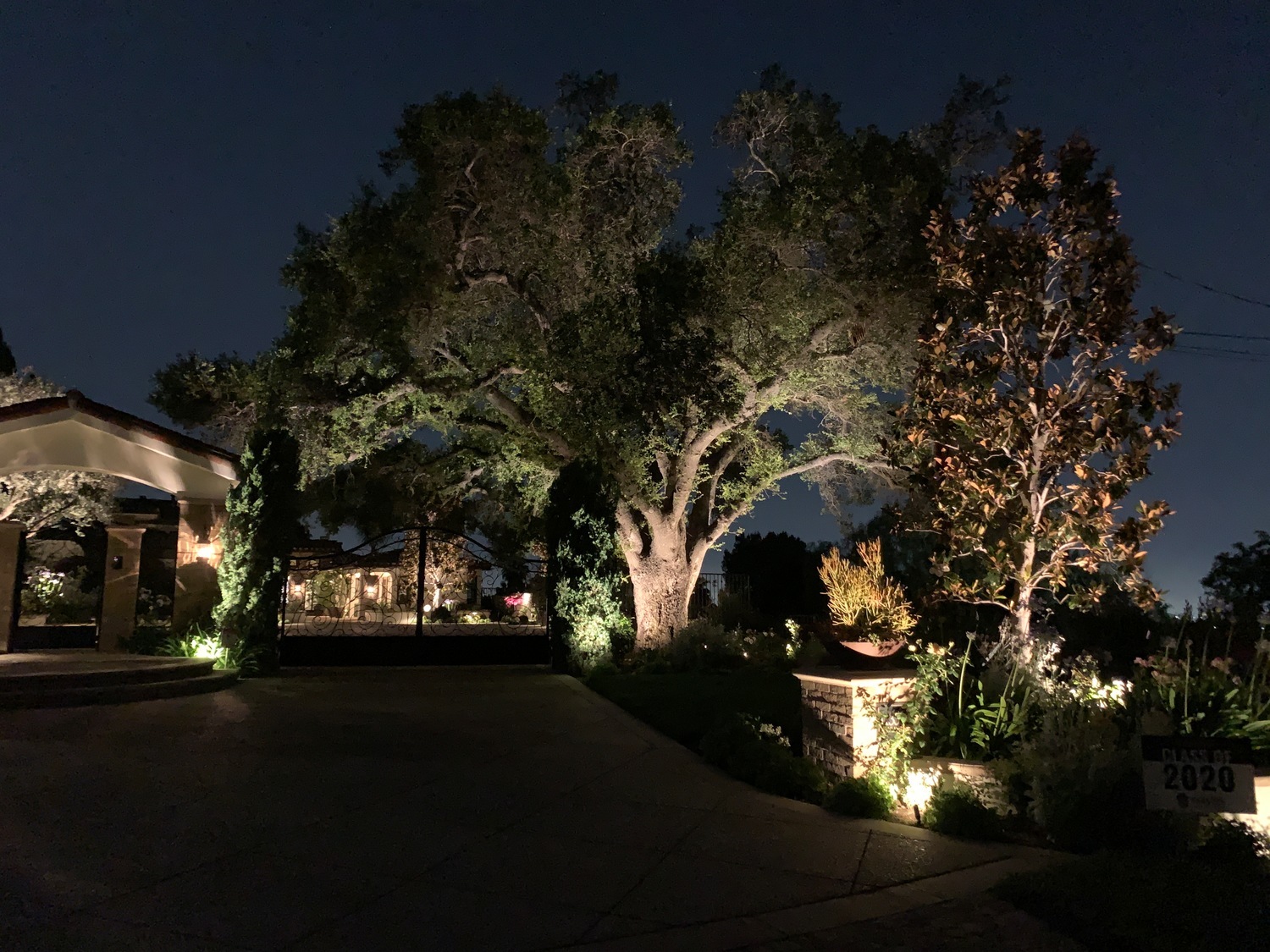
Professional tree lighting uses uplighting from the ground with adjustable beam fixtures. The goal is to reveal the tree's natural shape, not flood it with light, so placement, angle, and fixture count all matter.
One of the most common mistakes made with tree lighting is to take a single bright fixture, put it at the base of the trunk, and point it straight up. This turns the tree into a glowing pillar, and not in a good way. We’ve heard it called the “bonfire effect” (and not as a compliment).
We’re fans of putting a light on the ground a foot or two from the base. It can then be tilted to somewhere around 60 to 75 degrees. At that angle, the beam rakes across the bark. Doing this means you see ridges, and the places where limbs fork. The canopy fills in above because the light scatters through it rather than shooting past it like a searchlight.
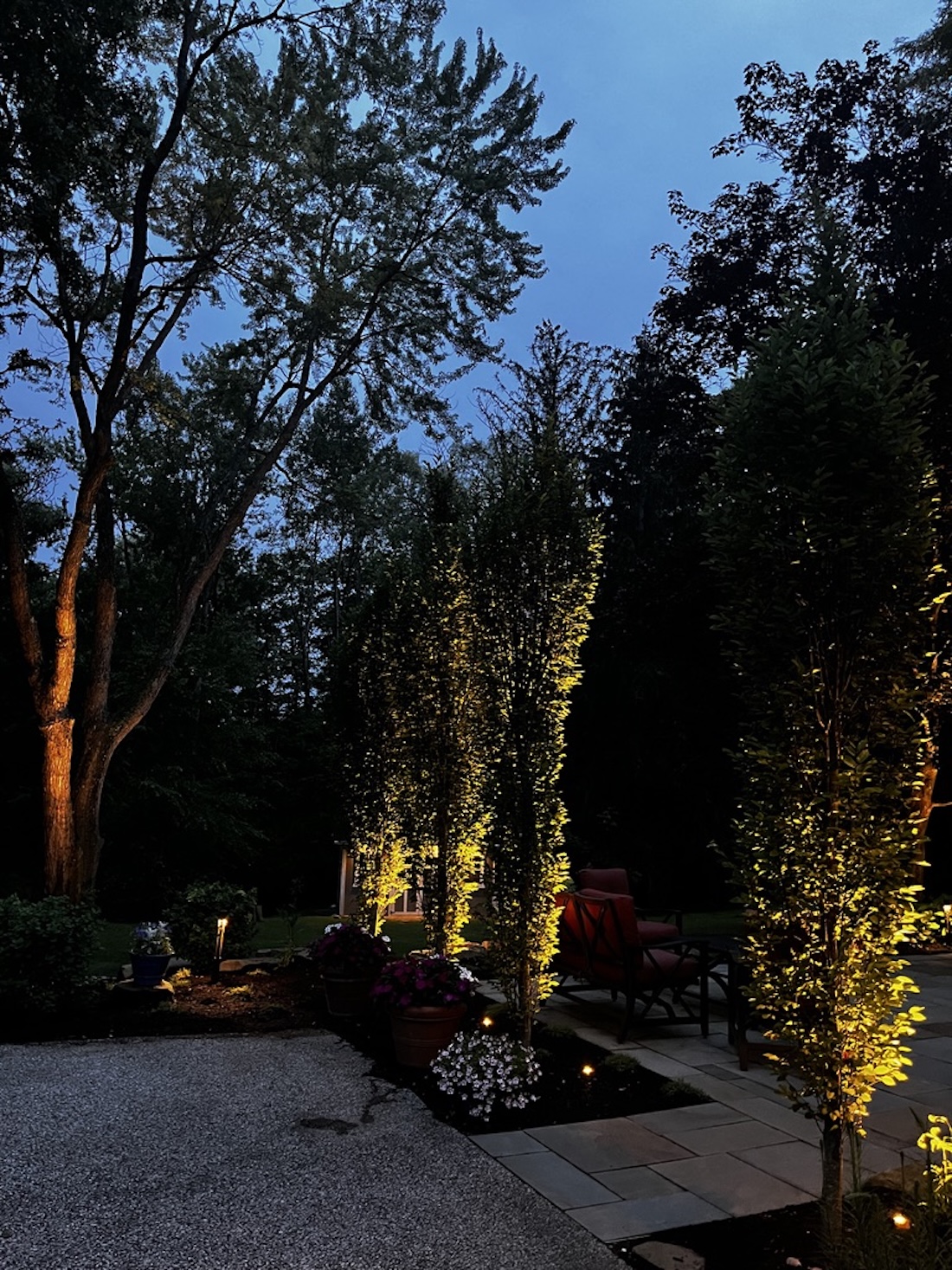
You might only need a single fixture on a small ornamental tree. Think the kind that you could wrap your hands around. For a big shade tree, you might need three or four placed on different sides so the light overlaps. This gives you a lovely sense of dimension (rather than a bright face and a dark face).
How wide the beam spreads matters a lot here too. A tight, narrow cone works if the tree grows straight up. Something broader makes sense on a spreading canopy where you want the light to wash across a wider area rather than punch through a narrow column. Northern Ohio is full of oaks and maples and elms with massive spreading canopies, which is part of why tree lighting is such a popular request in the Solon, Chagrin Falls, Hudson, and Aurora areas.
Then you have the moonlighting version. Here, a fixture goes up in the tree itself, mounted high in the canopy, shining down through the branches. It throws some beautiful shadows on the ground that shift when there’s a breeze. It’s amazing to look at in the summer. Then when all the leaves are gone, the same fixture that made dappled patterns in July throws bare geometric shadows in winter—another stylish look.
One more thing to consider here is color temperature. Bulbs ranging from 2700K to 3000K look warm and beautiful year-round. Push past 4000K, and leaves start to look gray in the overlighting, which defeats the purpose.
Outdoor Lighting Perspectives of Northern Ohio has a service area that sits in one of the best regions in the state for tree lighting, thanks to the mature canopy. When you work with the expert lighting technicians, they’ll help you choose how many fixtures you need, decide how they should be angled, and where they should go on each tree. Schedule a consultation or call (440) 336-8650.